1883 Bicycle mishap
While looking for something I came across the following in the "personal" section of the classified page of a newspaper:
"The party who drove a buggy into a bicycle on the 14th-st road yesterday will please send his address to this office. By doing so he will learn of what is thought of one who is not man enough to stop to see the extent of the injuries inflicted by his unmanly conduct."
-- "Display Ad 3 -- No Title. " The Washington Post (1877-1922) 2 May 1883 ProQuest Historical Newspapers The Washington Post (1877 - 1993), ProQuest. Web. 14 Jan. 2010.
Don't need a car to be a jerk.
Labels: history, transportation
Women, the past and home ownership
As I've stated before I'm not too keen on architectural history, in that I just don't have an interest in it. However, I do have an interest in property transfers and its history, as that tends to relate to personal wealth.
Today, I'll be covering myself in
red rot from old volumes regarding, some DC properties in the 19th and early 20th centuries. There are published books (Lusk real estate assessment directories, published by Rufus Lusk & Sons) listing the owner of the property. I noticed, running my eyes down the list of owners, I saw several repeats for a series of houses right next to or nearby each other. So you'd have say a Ruppert or a Richardson owning 4 or 5 houses on a block. And not all owners were male. Most were male, but not all.
Now going back to the 1900 census project, so far (I'm still cleaning up data) of the 1101 households, 892 rent. That is a huge chunk. 78 are owners with a mortgage, and 104 own their homes free and clear. Of the homeowners, 45 are women. Now, it would be correct to say that in 1900, not many women owned their own home. It would be also correct to say not many men owned their own homes either, since most rental heads were male.
Though not as popular as the career of laundress there were about 9 landladies and 1 female capitalist. Yes, ladies and gents, someone said their occupation was that of a capitalist. So in this turn of the century world there were women involved in the real estate game, as owners or property managers (landlady). Not many, but 1900 wasn't 2000 where credit was extended to anyone who could breathe for a home loan.
Labels: history
Don't fill out 2010 Census forms drunk
This year is when we will get the 2010 Census in the mail or if you don't get it or fill it out, census takers will come to your door. Anyway, my cousin has completed the 1900 census for the Truxton Circle area and I still got to mash the data up, clear out the non-addresses, and decide what kind of paper I want to write. The last enumeration district she had to do, was ED 63, and according to her complaint, the dude who was the census taker must have been drunk. Since it is 1900 I will concur on the drunk part, and not chalk it up to crack. The census taker's work was sloppy, disjointed, and simply disorganized. We imagine that he was staggering around eastern Mt. Vernon Square area asking random passersby where they lived.
Maybe he kept stopping by bars. I don't know about the number of saloons or bars in the TC area circa 1900 but apparently a lot of the Irish that were captured in our study were barkeeps. Yes, I know that just goes right into a stereotype. What can I say, our data has stereotypes. Don't blame us, blame the occupational landscape for Irish, and African Americans for 1900.
Back to our drunken census taker, he has made trying to clean up the data hard, and there will probably be some holes. So for the sake of any future researcher in 2090, please write clearly with a clear head, when you fill out your 2010 census form.
Thank you.
Labels: data/demographics, history
Euphemia Lofton-Haynes or Intellectualism doesn't pay well
It has been twice in one week I have referred to Dr.
Euphemia Lofton Haynes, first Afro-American woman with a PhD in Mathematics in conversation, not by name, but by accomplishment. Her connection with anything relating to me is that once upon a time she owned my house. She didn't live in it, it was an investment property. She bought it, rented it out, and later sold it, as she did with several other properties in the area. It was just one of many in her portfolio.
If the quick biographies of her, very few, if almost none mention where she got the money for living the life of an educator and social activist. She was the only daughter (she had a brother) of a dentist, so she came from some level of comfort.
She worked in public schools such as Armstrong and Dunbar, Miner's College, and later the president of the DC Board of Education. Positions, though highly respectable, don't strike me as highly lucrative. According to the biography
provided by the university that holds Dr. Lofton-Haynes papers, "the Haynes' family moved solidly into the upper-middle class, owning a substantial number of rental properties throughout the District."
She is rightly known for her educational achievements, but what supported her ability to become the intellectual and activist was not her income as an educator. Right now I'm meditating on what that means.
Labels: history
The past is a weird country you only get to visit via travelogues
I was chatting with my cousin about the census project. We were on the topic of occupations. Some bewilder her, like hustler and huckster and compositor. Then there are others where she was amazed at the sheer number of laundresses. Lota lota laundresses. Off the top of my head I was trying to remember the
history of Washington DC domestic service, along with the history of American consumer culture and the rise of the home washing machine and indoor plumbing, which would have made a laundress unnecessary. Later, conditions changed where the "need" & "supply" for domestic servants (another large female occupation) disappeared.
She also noted the large number of people in one house, also unusual for our time, normal for then. I explained that several houses in the neighborhood were two or more units. You can see it with some of the Bates Street houses still, where there are two doors, one for the lower unit, and another for the 2nd floor unit. Regardless, there would be three generations sharing a house or a unit.
Another shocking thing I told her, not revealed in the data, but coming from the whole laundress and plumber (a biggy for white males) discussion, was the lack of running water in many neighborhood houses. Yes, not every house had running water inside. Think of all the things you use that requiring water on command (toilets, dishwasher, shower, etc) and imagine not having that. I illustrate this for her I recalled one of our late grandmother's odd habits such as keeping a chamber pot under her bed. She had running water, but she was, eh, mentally ru-ral. The running water problem lasted up till about the late 50s or 60s in parts of Shaw.
Labels: history, neighborhood history
DC Urban farm, 1940
I'm going through some papers and I came across a snapshot of census records. Apparently in 1940 there were 65 people living on farms (or 65 farms the table is hard to interpret). Considering that not every mile of the District was developed, that there were some parts of the District used for agriculture.
Labels: history
Ten Days of Truxtun- The End
Day 10. I've been trying to figure out at what point Tom Truxtun went from Captain Truxtun to Commodore Truxtun. Apparently some time between 1800-1801, when he took command of the
President and before he quit the US Navy all together because of some ranking spat, that wasn't entirely Truxtun's fault. In 1801 the fake war with France ended and there wasn't much of a need for a wartime naval force. And it appears through some letters sent in 1802 about a meeting with the Secretary of the Navy, because he caught a cold failed to dine with the Secretary, who apparently wasn't that keen on him in the 1st place, who then failed to provide Truxtun with the requested personnel needed. It seems that Truxtun decided if he was going to get no respect he may as well quit. So he did and from 1803-1822 lived life as a gentleman living off of prize money won in earlier years. He had a farm, a couple for a while, but settled at Wood Lawn, a farm not far from Philadelphia. He served as a High Sheriff from 1816-1819. In 1822 he died, his wife a year later.
Ten Days of Truxtun:
Day 1-
The Name-The HoodDay 2-
SlaveryDay 3-
Commodore's backgroundDay 4-
What I did During the American RevolutionDay 5-
Continuing the Revolutionary WarDay 6-
Going for brokeDay 7-
In the NavyDay 8-
Not the British NavyDay 9-
Fake French WarResources-
Commodore Thomas Truxtun 1755-1822 by Eugene S. Ferguson. The free Library of Philadelphia, 1947.
Truxtun of the Constellation: The Life of Commodor Thomas Truxtun, US Navy, 1755-1822, by Eugene S. Ferguson. Johns Hopkins University Press, 2000.
Labels: history, Truxton Circle
Ten Days of Truxtun- Fake French War
Day 9. Friendships are funny things, particularly between nations. France was our ally in the Revolutionary War and our revolution inspired the French Revolution, well the revolution part not so much the beheading and turn the world upside down part. Anyway America made peace with Great Britain and in regards to the war between Britain and revolutionary France, the French turned on the Americans. Not officially though, they just sent privateers after American ships.
Thus the fake war.
In 1799 (as far as I can tell) Captain Thomas Truxtun had some significant victories over the French. One was the capture of
L'Insurgente, which was one of France's fastest frigates. The other was the severe damage of
La Vengeance, a much heavier ship that was bigger and had more firepower that Truxtun's
Constellation. Truxtun's newfangled ideas about discipline and naval training is credited to his victories.
Labels: history
Ten Days of Truxtun- Not the British Navy
Day 8. After some chatting with a friend whose knowledge of the British Navy in the 18th & 19th Century comes from reading novels and having a crazed roommate obsessed with the Horatio Hornblower series, we came to the conclusion that the last place you wanted to be was in the British Navy. There was the bad food, the floggings, the classism, disease, more floggings, and the warfare, 'cause no one likes getting shot at. Now Captain Tom Truxtun tried to move away from the British model with fewer floggings replaced with reprimands, and some idea about courtesy and mutual respect. The problem with the British system he wrote,
" A man of war is a petty kingdom and is governed by a petty despot... The little tyrant, who struts his few fathoms of scoured plank, dare not unbend, lest he should lose that appearance of respect from his inferiors which their fears inspire. He has therefore, no society, no smiles, no courtesies for or from any one. Wrapped up in notion of his own dignity, and the means of preserving it, he shuts himself up from all around him. He stands alone, without the friendship or sympathy of one on board; a solitary being in the midst of the ocean."
[Ferguson, 147]
So therefore let Capt. Truxtun inspire you this day not to be a tyrant to your interns or underlings, smile at your co-workers or remember to show them some courtesy in your dealings with them this day.
Labels: history
Ten Days of Truxtun- In the Navy
Day 7, in March of 1794 Congress decided grudgingly to support a Navy. The idea was 6 ships would be built, they would address the attacks from the Algiers on American ships, and once that's done disband and go back to being a shiny new nation. Well that was the idea. Tom Truxtun agreed to be one of the 6 captains of this American navy which limited his income. He would make more money as a merchant seaman than as a captain in the navy. Each captain was in charge of overseeing the building of his ship and Truxtun chose Baltimore for his ship. Unfortunately there was a huge problem with finding suitable live oak, needed to build the type of ship needed, which created delays and it didn't help that peace was achieved with the Algerians. In 1796 the US Navy was in danger of being dismantled, per the act of Congress that commission it, but was saved with the Navy bill signed by George Washington April 20, 1796.
Besides getting the
Constellation built, Truxtun's other great contribution to the Navy was creating a system of organization. The initial idea of the Navy was there would be 6 ships, six captains, and they would operate independently of each other. The nation was loathe to use signals and other customs from the Royal Navy, so Truxtun wrote a book in 1797
Instructions, Signals, and Explanations, Ordered for the United States Fleet. He stressed learning and the study of the naval arts in a profession that wasn't known for it's love of reading, or scientific study.
Labels: history
Ten Days of Truxtun- Going for broke
Day 6, in looking at the life of Tom Truxtun, for whom a circle was named, and that now gone circle names a 'hood.
Nothing truly exciting happened between the end of the Revolutionary War and 1794 in Tom's life. He got older, sailed the world, got into a scrape with John Paul Jones, had a bunch of kids, the usual. The notable things to mention was his career as a merchant seaman was pretty good despite nearly losing it all and going into deep debit because the post war economy went into the crapper. Apparently, printing a lot of money, speculating and importing and not really exporting is bad for a country.
Next, Ten Days of Truxtun- In the Navy
Labels: history
Ten Days of Truxton- Continuing the Revolutionary War
Day 5. When we last left Tom Truxtun was a privateer having successfully captured ships with the Independence in the Caribbean. In 1777 at the age of 22, Captain Truxtun of the
Mars, sailed towards the English Channel to take on British ships. The Mars, other privateers and the Continental Navy were also cruising those waters to pick of British merchant ships. When they overtook a ship, they would then go to the friendly ports of France, and have the items liquidated there.
In January 1778, he returned to America, specifically Boston, then later that year with his wife and child returned to Philadelphia after the British had vacated. In 1779 he captained the
Andrew Caldwell, which sadly was captured by the British as it was just in sight of the neutral Dutch island of St. Eustatius. After his capture he was able to get to St. Eustatius and there he made an effort to get back to America. While there he managed to buy another vessel and cargo to take back to Philadelphia. On the way back Truxtun hit what probably was a hurricane, off the coast of the Carolinas. In the storm he lost all of his masts but was able to limp home (while initiating an attack on the way) by creating a jury-mast(?) and a jury-rig. The ship he was on was the Lydia and he renamed it the
Independence II after she was fixed. The new name brought better luck in the privateering effort in 1780. Truxtun almost made a million dollars off what he was able to capture, however inflation was ever so increasing as the Continental Congress kept printing money.
In 1781, Truxtun managed to get himself into a fight with a British ship where both parties were hit pretty hard. However, later it was discovered that the ship was an American British loyalist ship out of New York. In 1782, General George Washington praised Truxtun's service at a dinner, remarking that he had, "been as a regiment to the United States."
Labels: history
Ten Days of Truxtun- What I did During the American Revolution
Day 4 of looking at the man for whom the neighborhood gets its name.
In my last post about Tom Truxtun I mistakenly said he was captain of the
Chance, I was wrong. After losing his first ship he captained to the British, he was just a prize lieutenant on the privateering ship the
Chance. Not because he lost a ship in the Caribbean but because he got to the investors too late and they had already chosen captains.
So in Spring 1776 he sailed out from Philadelphia on the Chance heading for the Caribbean to stick up British merchant ships. Which by the way was a very profitable enterprise during the Revolutionary War. Investors would get half the spoils, and the rest were divided amongst officers and crew.... once it got through the court system. The
Chance did well taking unarmed and out gunned British ships.
In the Summer of 1776 Tom Truxtun teamed up with a New York investor by the name of Issac Sears. Sears made Tom the captain of a 70 ton sloop called the
Independence at the age of 21. Apparently the British were holding New York's bay at the time so he had to sneak his ship out by going down the East River.
Somewhere in southern waters he managed to capture a ship that got separated from its convoy. In capturing that ship he got a hold of the signals the convoy was using. So he joined the convoy, showing all the right signals, blending in. At night he came close to a ship he thought was holding the greatest bounty, took it over and separated it from the convoy. His adventure with the Independence led in the capture of 2 brigs and two ships, though one did get recaptured by the British.
I'll continue with Tom Truxtun in 1777 as captain of the
Mars.
Labels: history, Truxton Circle
Ten Days of Truxton- Commodore's Background
Okay day 3.
Who was Thomas Truxtun?
He's a boy from Long Island, 20 miles from the "town" of New York. Born in February 17, 1755 son of a barrister who was working on his second family. His father had left the first set in Jamaica, West Indies. Tom Truxtun had about two years of formal schooling before he was sent off to sea at the age of 12. Though this reminds me of a Dicken’s plot, his mother had died and his father was working on family #3 and poor Tom gets apprenticed to the
Pitt. The
Pitt was a Bristol ship and Tom was to be cabin boy. At the age of 16 he was pressed into His Majesty’s Royal Navy (remember America was still a colony) during some international flap between England and Spain. After England and Spain settled peacefully Tom Truxton, went back to merchant seamanship on the
London.
When he was 20 years old he became captain of the
Charming Polly and married a 15 year old girl named Mary in 1775. He was captured in that same year, due to hostilities between the British and the American Colonies, lost his ship (of which he’d owned ½) when overtaken by the Brits in the Caribbean. When he got back to America he became a
privateer as captain of the Chance exacting his revenge on British ships in the Caribbean.
Next- Ten Days of Truxton- What I did During the American Revolution
Labels: history, Truxton Circle
Ten Days of Truxton- Slavery
I've heard of an objection to Truxton's name because he was a slaveholder. The whole city is named for a big old slaveholder. Worse yet, we've got a big phallic symbol on the Mall in honor of Washington, not far from that other memorial from another slaveholder, Jefferson, who also owned a number of humans.
The big biography by Eugene S. Furguson has very little to say about Commodore Thomas Truxton and slavery. Just one paragraph speaking of a period of then Captain Truxtun's life when he was a on financially shaky ground and his family was growing with 6 girls and two boys. And the family seemed to split their time between Cranbury, New Jersey and Philadelphia:
Their Negro servant, Hannah, was still with the family; but Captain Truxtun, influenced by his late friend Franklin's stand on slavery, had set her free on condition that he never be called upon to support her, should she leave his employ. Apparently she had chosen to stay on.
The Franklin mentioned is Benjamin Franklin.
Then the question is why did Hannah choose to stay. A couple factors might explain, she's a woman, possibly alone with no family, possibly no supportive Afro-American community in Cranbury, her age may've played a factor, and it's 1794-95.
So Truxtun's sin was owning at least one woman who didn't leave when the opportunity to do so was presented. For some that's unforgivable and puts him in the same league as worse transgressors such as Washington and Jefferson. Others may not count it against him in light of what he has given to fledgling US Navy.
Next Ten Days of Truxton- Commodore's Background
Labels: history, Truxton Circle
Segregation Map
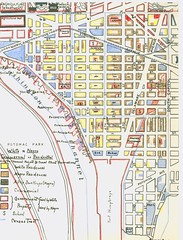
I got excited when I discovered this map from 1938. It is a hand drawn map of Southwest DC, much of which really doesn't exist anymore. What it shows are negro and white commerical and residential areas as well as black occupied alley dwellings.
Demographic info is so cool.
I find it facinating because it further chips away at the ideas I had about Southern segregation. I always imagined it as very distinct, blacks on one side of town, whites on another and you won't find one in the other's neighborhood. My own (on again/ off again) study of Truxton Circle and this map shows a little mixture. The brown represents Afro-American street facing residences, black for black alley dwellings, and the yellow for white street facing residents. There are a few all yellow blocks, but there are plenty of yellow and black blocks, and yellow/ black/ brown blocks. The blue os commerical space.
Labels: history, other neighborhoods
Before the ANCs
Everyso often I see on
other blogs commentary about the
ANC system here in the District. Suggestions on how to improve them varies, but I wanted to share something, which may or may not add to the discussion. The ANC system came about after Home Rule in the 70s and are in line with the Ward system. Before Home Rule there were the civic (black) and the citizen (white) neighborhood associations that would advocate for city services.
I noticed, when poking around in early 20th century DC history, some associations' borders kept changing or had proposed changes due to population changes or other reasons. In 1925 the North Washington merged with the North Capitol and Eckington Citizens Asssociations to become the North Capitol Society. The reason was the two groups tended to overlap and replicate each others work.
Even after the ANC system, there were changes in size and number. The system that was put in place in 1974-1976 does not look the same as the one we have today. So changes can be made, because they have been made.
Labels: ANC, city services, history
Historic house in LeDroit
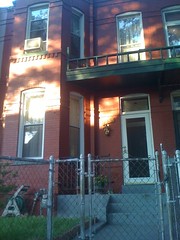
Yesterday I wandered over to 3rd Street NW to admire the history. Please note this house, the chain link fence, the history! Some folks know the significance of this house, which currently is a private home from all indications. So please do not harass the occupants. Up until a few days ago I had passed the house on a few occasions without noting its importance. Then one day I was cleaning off my desk at work and there was this brochure for the National Archives' Regional Archives- Southeast Region in Morrow, GA. As objects of interest they had on the brochure national registration cards for notables who at the time probably weren't that notable when they filled out the card. Of the five cards there are the names and then current addresses for
Huey Long, Jr.,
George Herman Ruth, James E. Carter, and Harry Houdini. And also some
guy named Ed who lived on 3rd Street.
----
The house was one of several homes occupied by Edward Kennedy Ellington, also known as Duke Ellington. He was 19 when living at the house pictured.
Labels: historic districts, history, other neighborhoods
Ridge Street, again
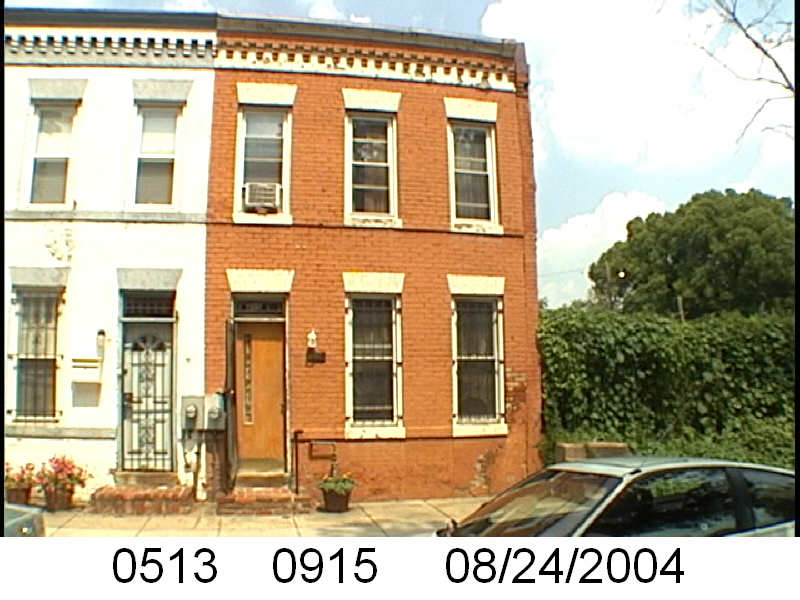
Once again no body entered my contest. When you realize how easy it was you'll kick yourself. It was:
Here's the question, what is the address of a Ridge Street NW house that is still standing today but in 1940 was listed as "old and in poor condition" or "poor condition"?
473 Ridge Street NW is up for sale for $379K. In 1940 it's assessed value was $1,557, and described as "1 2 story frame, 4 rooms; no improvements; very old and in poor condition."
The house pictured is 425 Ridge Street. In 1940 for 425-425 1/2 Ridge Street the assessed value was $3,732. The description read as follows, "2 2 story bricks, divided into 2 3-room apartments or flats each; no improvements except inside water; old and in poor condition." The monthly rental for it was $70 and it held 4 families, a total of 19 persons.
So seriously the only Ridge Street houses NOT described as being old and in poor or terrible condition were, 413, 457, 475, 458, 438, 440, 442, and 444. 458 was a blacksmith's shop and garage, so it wouldn't have mattered.
Ref- RG 302 P-1, Folder Sq. 512 & 513.
Labels: history, other neighborhoods
How quick can you grant write?
May 1st is the deadline for the
DC Community Heritage Project grant. Taking a look at past recipients of the $2000 or less, grants, there is a wide range, from community arts groups, garden clubs, civic associations, and main streets. The kind of humanities projects the Humanities Council is looking to provide grants for are:
Book Discussion
Conference
Curriculum Development
Debate
Discussion Guide
Exhibit
Film Discussion
Film/Video Production
Historical Dramatization
Humanist-in-Residence
Oral Histories/Interviews
Panel Discussion
Historic Preservation guides
Radio Production
Research
Scholarly Editing/Publishing
Seminars
Site Interpretation/Tour
Teacher’s Institute/Seminar
Workshop
Labels: Art, history, non-profits/advocates