Gentrification and Theatre
This weekend I and the Help were invited to see the play Clybourne Park at the Woolly Mammoth Theater down in Penn Quarter. According to the
theater’s website on the drama and the promotional information:
Clybourne Park explores the evolution of racism and gentrification over the past half-century in America by imagining the conflicts surrounding the purchase of a house in a white neighborhood in the 1950s by an African American family, and then the re-design of that house in “post-racial” 2009. While Clybourne Park is a Chicago neighborhood, the play makes no direct reference to its geography. Woolly believes Clybourne Park is highly reflective of the changes happening to neighborhoods throughout DC and across the metropolitan area (and urban America).
And it is a riff off of
Raisin in the Sun with the first half of the play taking place in the home of the family selling the home (that we assume) the RITS’ Af-Am Younger family. I thought that first half started a little slow.
I really appreciated the director’s commentary after the performance at a reception. On one point as urban DC people living in 2010 we know how to judge the characters of 1959 in the first half of the play, saying with confidence Mr. Lindner, from the Clybourne Park Improvement Association, is wrong in arguing against selling to the Black family. However in the second half, taking place in what I gather to be 2009, that moral surety is not there and issues of race and gentrification are tied up in arguments about ‘history’ and architecture.
Since the Help and I are both in the History field, we pondered the ‘history’ part for a while. We also pondered the racial and chronological make up of the audience at that performance. History is messy and we found it interesting that one of the Af-Am characters was pushing the idea that the desired preserved history started with the integration of the neighborhood, not its establishment or previous ethnic makeup. Also when the Help (the whitest white guy who was ever white) pointed out the demographics of the audience which had a smattering of Afro-Americans, I mentioned audiences like my Aunt and her friends tend to favor Tyler Perryish morality plays over at the Warner Theatre.
The second half of the play does try to press a lot of gentrification topics into 6 characters. Two topics did ring a bell in relation to stories and events witnessed in the Shaw neighborhood, history and racial defensiveness. The Shaw historical narrative isn’t wrong, it just leaves a whole lot out that isn’t particularly marketable in the larger “Heritage” theme. And one character reminded me so much of a former neighbor who was one of those isolated* white families who moved to Shaw, who tried to be a good neighbor but had to walk on eggshells every time they interacted with their Black neighbors because even the banal issues were hidden roadside bombs of pent up racial anger.
UPDATE- Theater Discount
Readers of this blog can see any performance of Clybourne Park for only $15. Use this numeric code 789 when arranging tickets. Reservations can be made online (woollymammoth.net), over the phone (202-393-3939), or in person (641 D Street NW, Washington, DC). Clybourne Park runs March 15 – April 11, 2010. Performances are Wednesday, Thursday, Friday and Saturday at 8pm and Sundays at 2pm and 7pm. Questions? Visit woollymammoth-dot-net or email Rachel Grossman, Connectivity Director, Rachel-at-Woollymammoth.net
*Isolated in that they were the only white people on the whole block.
Labels: Art, gentrification
CDC comes up with something dumb
(Hattip to
Frozen Tropics)
The CDC (Center for Disease Control), which I would like to trust for their timely health information has put something out that erodes that trust. Eroded, because
Health Effects of Gentrification, is stupid.
I don't deny that displacement because of neighborhood demographic changes is stressful and stress impacts ones health. According to the CDC:
These special populations are at increased risk for the negative consequences of gentrification. Studies indicate that vulnerable populations typically have shorter life expectancy; higher cancer rates; more birth defects; greater infant mortality; and higher incidence of asthma, diabetes, and cardiovascular disease. In addition, increasing evidence shows that these populations have an unequal share of residential exposure to hazardous substances such as lead paint.
So is the CDC saying that gentrification, not poverty and poor housing is the cause of shorter life expectancy and asthma? Are all those new middle class residents moving in and fixing up vacant and run down houses polluting the air with lead paint? Is that what the CDC is saying? Because in poor neighborhoods in no danger of gentrification or reinvestment are healthy, lead free, utopias where the Popeye's serve low fat vitamin rich meals and the corner mart has fresh fruit and lettuces. Oh wait, no. Those poorer neighborhoods in the other part of the District (think outside of NW) aren't healthier because there is little to no gentrification there.
I see there was nothing for 'Health Effects of Poverty' because gentrification is a nice way to distract attention away from chronically poor neighborhoods.
Labels: gentrification, health
Gentrification of Sesame Street
Sesame Street gentrified and I blame Elmo.
Others blame Elmo as well, showing how this annoyingly voiced red hyper monster destroyed SS single-handedly by taking up a huge portion of screen time.
When I was a kid, we had two channels, NBC and PBS. So after I got home and Mom finished watching Days of Our Lives, I turned the channel to the PBS station to watch Sesame Street. People walked along, bumped into each other, started conversations, or ventured over to the independently owned shop "Mr. Hooper's" and hung out, as people do here. Kim Wee as Mr. Hooper, because that's the only small shop I hang out at, if I am hanging out anywhere. But unlike here, SS isn't as trashy. We have more Oscars, and more guys in the alley (but unlike the SS characters they aren't trying to give us a good deal on the letter "A").
Labels: gentrification
Turnover part 2
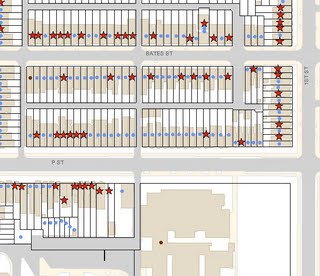
This map is of houses sold on these few blocks between 1999 and this year below $500K. There are still plenty of red stars representing sales. The blue are more than likely houses that sold prior to 1999, or the odd property selling at $500K and above. Since I did throw in the more than $500K on the map (not shown) it seems there were a few but not many. Comparing the map from
Turnover part 1 to this one, a majority of the 1999-2009 sales were less than 1/2 a mil.
Yet the thing that I find really interesting is not so much the amount houses finally sell for, but the fact there are so many houses that change hands in a 10 year period. It seems to reflect the transient nature of DC or the investor fueled real estate boom of the 2000s.
Let's say, for the most part, that the blue dots represents long timer residents and the red stars newer residents. It isn't perfect, as the blue dots could be rentals that turn over every couple of years but never sold, and red stars rentals bought by new investors that remain rentals. On my own block one of the red stars was a rental home that the renters later bought from the owner. But anyway let's say those red stars represent new blood on the block, in some spots, except that part of the 100 block of P, there is a fair amount of turnover.
If you get on the DC gov website and play with the
DC Atlas for Real Property and compare and contrast with other parts of the city regarding final sale prices (which sometimes isn't the listing price) and turn over, it's interesting.
Labels: data/demographics, gentrification
Turnover part 1
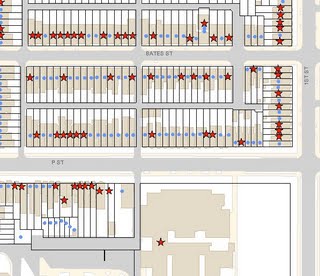
This was stolen off of the DC government's DC Atlas website and what it shows are houses sold between Jan 1, 1999 and yesterday. More accurately it shows houses sold for more than $1 and below a billion. I had to throw that in when it showed every house with a red star and I discovered the database had some quirky dates of homes being bought by their longtime owners for 0.00, and had to find a way to exclude that misinformation.
Each red star represents a property sale, that's it. However, one can make guesses that a majority of those sales resulted in some turn over.
Labels: data/demographics, gentrification
"No one wants to live near poor people"
...isn't exactly a correct comment, but I have seen it a couple of times on the web regarding mixed income housing and gentrification. I'm mean we're living in Shaw not Woodly Park or Chevy Chase. I have a hard time imagining that people who bought housing, oh east of 9th Street, were caught completely off guard by the subsidized housing that dots the neighborhood. Than again, maybe some were.
I think of Shaw as economically diverse. You have neighbors in longtime poverty and short term (young, just starting out, etc) poverty, the elderly and disabled on fixed incomes, and others whose incomes wax and wane depending on clients, contracts, sales, rentals, or what have you. But I don't think it is so much a neighbor's poverty is as it is their dysfunction. Grad students are broke, but hardly anyone is up in arms about graduate family housing. Plain college students can be broke also (depending on their sources of support) but neighbors do tend to oppose their housing as that population can be a bit too rambunctious and loud, not because they may or may not have money (see Catholic U area for examples of such conflicts).
Shaw's diversity, economic, racial, etc., is a strength and a challenge. Crime is a huge challenge, so are the blocks of concentrated poverty. In mixed income areas we learn from each other. The more middle class residents learn about the various programs for neighbors in need, the more they can train themselves to be supportive of programs that work and harshly critical of ones that fail and are nothing but fronts for poverty pimps. The more I learn about
Bread for the City (CFC# 61733), and
N Street Village (CFC# 90946) the more I am impressed by their work and efforts.
But let's wander back to the question of mixed income housing and if it is possible, would non-poor people be willing to live next to poor people. Well in Shaw, we already do, in townhomes. I have a hard time telling, as it is from causal observation over the years, but the
Washington Apartments, along 7th and 6th Avenues, appears to be slowly becoming more racially diverse. As far as I know they aren't subsidized housing, but I do get the sense that those apartments are economically diverse. Feel free to correct me if I'm totally off base.
Labels: charity, gentrification
Economic identity
A comment I got here annoyed me, in the same way that being called white annoys me. I'm an African American, but a pale one, so the attack on my identity, as I see it, irks me. Same thing with the discussions of gentrification and neighborhood change, there is a string of thought that fails to see a neighborhood's residents in terms of grades of economic diversity. Instead it is the rich, that being anyone not in subsidized housing or elderly on a fixed income, and poor, and very little in between.
Sometime back I got an inquiry from a journalism student, who asked about neighbors couching it it terms of poor neighbors vs rich ones. The more I learn about my neighbors the more I know what I don't know about them. I can guess whose house is a Section 8, whose retired and on a fixed income, but knowing if someone is on food stamps or other forms of state assistance, I don't know and really it isn't any of my business. Same thing for other neighbors who have jobs and careers, So-in-So works for the government, Theotherguy works as IT, She is a freelance graphics artist, Blahblah is an Asst. Director at a non-profit, and Whatshername does something (I'm not sure what) at Pepco. Are these people rich? Wealthy? Not likely. But they are more apt to be 'wealthier' or 'richer' than neighbors who are unskilled workers or persons starting out in their careers or others for whom employment is problematic. Anywhere else in America So-in-So, Theotherguy and the rest are just middle class people living on a cul-de-sac, here, we become fabulously wealthy.
The money to buy our homes comes from savings, sometimes family members, recently deceased grandparents, and raiding the old 401K for the deposit. The renovation money from 2nd mortgages, building loans, family, savings and once again raiding that 401K. We turn to same resources the rest of middle class America does. Because we're next door or down the street from people whose economic state is more dire or more obviously distressed, the side by side comparison makes it look like two extremes. Rich and poor.
Labels: data/demographics, gentrification
Gentrification Reducing Downward Mobility?
I really wish the findings of a
Pew Trust report (PDF) regarding economic mobility was a little clearer. The best I could figure, before they threw in the math equation, which totally lost me, is that when a neighborhood decreases poverty a child's chance of heading downward as he/she grows up decreases. Yeah, there are a lot of negatives, unfortunately it isn't clear when you make the sentence positive that there is the data to back it up. A positive sentence would be that when a neighborhood becomes richer, or parents move into a neighborhood with less than 10-20% poverty, their children will grow up to become successful adults who make more money than their parents. What was clear was a child growing up in a poorer neighborhood where poverty was 20% or more is more likely to become poorer.
I was reading the report trying to figure out if gentrification, or the lessening of the rate of poverty in a neighborhood, had any positive for poor children who remain in the neighborhood. The best I can figure from the report is that it doesn't hurt. Apparently there weren't enough families in the study group who moved from poor neighborhoods to neighborhoods with less than 10% poverty whose children became upwardly mobile adults.
Labels: gentrification, kids
How I know things are better: cars
One morning I observed a city owned tow truck moving a car on New Jersey Avenue and I was reminded of a question. The question was asked in relation to gentrification and changes in the neighborhood, and it was "what is better?" Because I say that things are getting better and one way I know the neighborhood has gotten better is with parking enforcement.
There was a time when cars would get dumped on our street and they would sit. For days and weeks. While they sat, they attracted trash that would collect under the tires. We
STRONGLY suspected that our friendly neighborhood drug dealers used the cars to stash drugs. Then there were the cars that were stolen, some with broken windows.
Well as good citizens we'd call up the city and ask for the cars to go away and early on it seemed like we were ignored. Because I remember there was a car parked near or under the poo-poo tree and I reported it, several times. And it did not go away for over a month. I'd report it, wait a few days or a week and report it again. I pondered paying a tow truck to make it go away and ditch it in Maryland. But it eventually went away, but it wasn't the only car that was left unmoved.
Now, the city actually enforces the law. They ticket, a new thing that they started a few years ago. Also in the last few years they boot cars. I credit this to the demographic changes in the neighborhood with more active voters who try to hold the city accountable and demand decent city services. It is not that there weren't any politically or civicly active people here before, it's just that there are now more of them, which helps with burn out.
Labels: city services, gentrification
Found on the Street- Gentrification Rant
I'm going to make this quick. I found an interesting flier on Bates Street yesterday. It appears someone decided to print out some of their
blog posts on gentrification and leave them on the doorsteps of several Bates residents.
I may or may not talk about this more, but the thing that gets me is the
tortured logic regarding race and gentrification, that would define Asian-Americans as White. And it doesn't even go into the main elements of gentrification, just homelessness and definitions of other non-black ethnic groups as white. Gah, if you're going to print something out and pass it out, stay on topic. That's just my suggestion.
Labels: gentrification
Appreciation to those who came before
The Bladgen Alley blog Baanc Blog
has posted a picture of 1258 10th Street NW back in the late 80s. It's so depressing looking. Gawd, would you want to live across the street from that? Next door?
There were parts of the eastern parts and mid parts of Shaw that looked like that when I was house hunting in 2000. Somewhere off U Street was a place I called the house of the ugly people. The block of the ugly people was kinda run down too. Now. As
1258 10th Street is now, it has come a long way, being a bit beyond my economic level. But then again my own house is beyond my economic level, good thing I bought it when I did.
Looking at the roughly 20 year difference in the pictures just makes me thankful for all those who stuck it out, those who tried and held back the decay as long as they could before retreating to save their sanity, and especially those who tried to make the neighborhood better but lost their sanity/ patience/ money/ life in the process. I'm on my block because of my neighbors L&D and Miss B who came 15-20 years before me, who fought against the drug dealing, pleaded with the city for services, and on their own tried to make their and their neighbors' home a little oasis. I'm thankful to the neighbors, no longer on the block, like Pam & John, who did their part, said 'I'm done' and retreated to the suburbs or other parts of the city to recover.
Labels: gentrification
Gentrification re: Loaded
Frozen Tropics
mentioned it first. Sankofa Video and Books up on Georgia Avenue will be 'exploring' the issue of gentrification
this week. According to them:
The panel discussions will allow the community to thoroughly examine the implications of gentrification, gentrification and racism, the institutionalized gentrification, the economic implication of gentrification, the implication of culture gentrification, the appropriation of African American cultural icons for the benefits of the 'gentrifiers', and the following questions will be addressed:
Have they come to live with us or displace us?
Who owns the planet?
Gentrification: Latest stage of colonial power - or - it's relationship to colonialism?
I see a bunch of loaded questions and statements. Yes, the word gentrification is loaded, but you can additionally pack it with more explosives and how you pair it with other loaded statements.
I'm going to take a wild guess and say the answer to question one will be displacement. Maybe the idea of living with people you're implying are colonial oppressors may be batted around for a minute. But seriously, colonialist oppressor is not a nice title and you damage your radical whatever cred by coddling 'those people'. Does one become a colonial oppresser by virtue of simply living east of 16th St NW? Is this an opportunity to rail against the
Fair Housing Act, which allows people to legally live wherever the heck they want.
Here's a question, is the ideal located in places in DC (parts of NE & SE) where gentrification is not occurring and probably will never even bubble slightly in the next decade or two?
Labels: gentrification
Sort of Retelling/rewriting History
I'm trudging through Monique M. Taylor's
Harlem: Between heaven and hell which looks at the role of the black middle class and gentrification in Harlem. Harlem, has a special place in AfrAmerican and American cultural history, so there is that attractive and laudable past that attracts middle and upper middle class blacks.
In the first chapter Taylor writes how Harlem came into being via a real estate bust. Speculators bought up properties in Harlem around the turn of the 20th century because the Manhattan subway or street car (I'm not clear which) was coming up to Harlem and well, you know. Too many houses constructed, too high of a price, and then the bubble popped. Sound familiar? In this economic crisis " many landlords were willing to rent properties to blacks. ... Others shrewdly took advantage of white prejudice. The hope was that by placing blacks into certain properties, neighboring whites would vacate their properties and free them up at extremely low prices."[1] Around the mid to late 1910s Harlem became a majority black neighborhood. Then by 1920 notable and influential black organizations had established or relocated themselves in Harlem. Over time the positives that Harlem is known for flourished.
However, while there was this great Harlem Renaissance taking place, the glory outshone the negative side of Harlem. The unemployment, the crowded living conditions, the poverty and segregation. The famous Cotton Club was for white patrons only. The realities of the negatives resulted in large homes being carved up into smaller units to crowd poor people into and when the glitter of Harlem's shine started getting dull a depressing ghetto began to show underneath.
The background is needed to understand the black middle class who come to or returned to Harlem to 'restore it to it's former glory.' As I was reading the stories of the black mid class (let's say buppies for short) fixing up properties I noticed something. They are making the buildings reflect their pre-black neighborhood past, while lauding the Harlem Renaissance period. You mix your time periods long enough they meld into one, so that it is easy to imagine people like us (buppies) living in the grand houses and participating in the Renaissance. No one in the book, so far, has confused the periods, but the thinking seems to skate very close to it.
The book is very interesting in addressing class. But class seems to be too clunky and static a term. Taylor does show in one example how the relationship between buppies and poor blacks goes from we are all one to those sorry so-and-sos. Maybe more about that later.
[1]Taylor, Monique M. Harlem: Between heaven and hell. University of Minnesota Press. Minneapolis, 2002. p. 5
Labels: gentrification, history, other neighborhoods
Empower DC
I'm in a good mood. I've got my hot cup of British blend tea and a warm bacon, egg and cheese sandwich on multi-grain toast. Life is good. So in this good mood I'm looking over the newsletter sent to me by
Empower DC.
Normally, I'd just delete it as it is lefty activist stuff, but as I said, I'm in a very good mood.
According to their email "Empower DC seeks to enhance and improve self-advocacy efforts to improve the quality of life of low-and moderate-income people in DC." And looking over their newsletter, which is not available via their website (as far as I can tell) and their website they are challenging developers and private uses for DC owned property. Their newsletter has a series they are documenting and they describe it as so:
This is the first in a series of regular reports, entitled “People's Property Now”, to be released by Empower DC's People's Property Campaign, providing information and analysis about the fate of public property in DC.
Empower DC's People's Property Campaign asserts that:
• As long as community needs exist in DC, there is no such thing as “surplus” public property.
• Public property is the common trust of the residents of the District of Columbia and must be maintained as public for current and future generations, and used for the public, not private profit.
• DC's current law only provides a process for disposing of public property. Legislative change is necessary to create a transparent, community-driven input process to determine new public uses for available public properties.
I'm near the end of my sandwich and tea, so let me add my gently to the right opinion. One, why so critical of charter schools? Kingman Park is listed as being an example of 'currently threatened property' because it is slated to be a charter school. In the TC part of Shaw, Armstrong School languished as a city owned property and finally (it seems to have taken forever) the school has been cleaned up by the charter school in charge of it now. I do applaud Empower DC recognizing that McMillan Reservoir is green space, however it isn't accessible green space, except to Canada Geese. My last comment is on DC owned land. It is not that once land is sold that DC won't or can't get land ever again. The DC government, as many governments have the power of eminent domain, they can seize property for unpaid taxes or other wrongs against the city and add to the city's catalog of properties. Also DC owns enough nuisance properties, and we can point to a dozen city owned problems in Shaw alone owned by the city. If the city can offload these problem properties, turning them into housing (luxury, rentals, mod-income, mixed-use, whatever), with people who pay income taxes, the city and the surrounding community benefits.
Labels: development, gentrification, non-profits/advocates
Book Review: Home Girl: Building a dream house on a lawless block, pt 2
See part 1
here.
One chapter says it well, "Nice Bones, Rotten Organs". Besides the drug trade going on outside the author's house the other main drama of the book is the renovation of the house she bought in Harlem. I have to say I've been lucky. I found one main contractor for the big stuff and I have stuck with him and it has been a good relationship. The author, Judith Matloff, sadly has a multi-ethnic, multi-skilled, multi-competent, crew tearing her house apart at any one moment. Old houses are like old people, they are charming but they do have problems that come with age, and poor maintenance. Part way through fixing the place up she calls in some experts who come up with a laundry list of things that needed addressing.
I'm also lucky in that I got to live in my house long enough to have a clue of what it needed and how I wanted to live in it, before taking on major renovations. I know, for me, that my bedroom only needs to be functional, and not some oasis or retreat from the world. And then there are a bunch of things that I wanted to customize to the way I live and want to live (radiators, claw foot tub, Corian counter tops, etc), that no developer could ever foresee. But enough about me.
The second major theme is the business of drug dealing and it is a business. It confirms Sudhir Venkatesh's work in looking at the drug dealing that goes on in the streets of Chicago, NYC and DC as a business with a hierarchy. In
Gang Leader for a Day, the manager of the drug trade was J.T., in this book it is Miguel. Our street has one too, and so reading Matloff's and Venkatesh's experiences, re-affirms what I am (thankfully) seeing less of, on my street each year. Managers, main drug leaders, whatever tend to be a little older (in their 20s or early 30s) and keep their foot soldiers, the younger men selling, running, looking out, etc in line. A manger's primary interest is to move product with as little interruption as possible. Which on the good side means they are not interested in starting up turf wars or any other activity that would bring greater police presence. This is illustrated (in a chapter I'm currently at a loss to find), when the author is very pregnant, is threatened by a female crackhead and her boyfriend on the author's front stoop. She calls the cops, however Miguel lets it be known that if she had just informed him, instead of calling the cops (bad for business) he would have taken care of it.
I know it sounds strange, but in these situations it is not unusual to work out some sort of 'peace' with the dealers, while at the same time battling the drug trade through other channels. As a middle class (white <- gets you extra bonus points) homeowner, you are a factor to be managed, just like the drug runners are managed. Maybe fear motivates you, or maybe a desire for peace and quiet. You're too expensive to buy off or not needy enough to buy into the underground economy. If you're white, I and a few others, perceive that your calls to the police carry greater weight. So the manager of the drug trade has to 'manage' this factor.
This working relationship is an aspect I really appreciate about
Home Girl. Matloff, I believe shows how these things come into being, and explains it in a way of why such a thing is maintained. This is just one of the many issues and challenges of moving into and living in a transitional neighborhood.
I'll follow up with more, when I get around to it.
Labels: crime, gentrification
Book Review: Home Girl: Building a dream house on a lawless block, pt 1
Several weeks back I got an email from the author's publicist regarding this book about a woman who buys a fixer upper brownstone in Harlem on a street filled with Dominican drug dealers. In a quick summary I think the book will speak to several who have gone through or are going through the same experience, in other neighborhoods and cities.
We're perfectly aware that demographic changes, that in shorthand we call gentrification can be hard on struggling old timers. After reading this, the author, Judith Matloff, illustrates that it's no picnic for the new group moving in either. Fixing up and living in a house, having to deal with contractors of varying skill, competency, and temperament, is not fun. Nor is having to navigate through an active open air drug market to get home. Or living next door to a crackhead squatting in the building next to yours, who harasses you and your spouse, and has occasionally broken in to your house and caused damage.
I'm reviewing the book in parts. This part I'll deal with the first 7 chapters of this 25 chaptered book. I can say quickly that it starts off slow. I recognized the necessity of explaining Ms. Matloff's background as a devil may care foreign correspondent in dangerous war torn/corrupt countries. However, I found the first couple of chapters dragging and I wanted to get past the biographical material as soon as possible.
It begins to get interesting when she begins working on the house in chapter 5. In the next chapter she recalls a statement that I feel is unfortunately true:
...Three policemen on horses clopped past and told the dealers at Salami's house to move on. The muchachos ignored the cops, and the horses rode on.
"There goes the cavalry," the woman remarked dryly. "They can't do anything. It's legal to loiter. You bought this house?"
"We're under contract."
"I'm glad someone finally bought it." Her eyes swept over my dust flecked jeans and untamed curls. As she pursed her glossed lips, I got the impression that I wasn't her first choice of a neighbor. "That house has been empty since the doctor died six months ago, It's a blight on the block. I hope you have the energy. If you don't mind my saying so, and please don't take this the wrong way, the police will listen to you whites. They don't take us black folks very seriously when we complain about the problem."
The woman is her neighbor Leticia, and old timer who invites her to a police meeting and into her home to talk. The author notes the pristine condition of Leticia's home and writes:
This was yet another reason that our house was so cheap. It had been destroyed. Ruined. Wrecked. Lecticia's immaculate abode was the 'before' version of my house.
....
In sharp contrast, my dilapidated property was a museum of the crack epidemic. It served as a reminder of all that had destroyed Harlem: crime, looting, despair, poverty, failing schools. My house screamed, "Neglect."
Labels: gentrification
Chi-town gentrification tour- surface impressions
Chicago, like New York, but without the pesky New Yorkers and surrounded by Midwest farmland. I took a bunch of pictures, and I need to download them and label them properly. Then again 1/2 of them may be crap and only worth a delete button.
This weekend I did the Robert Taylor tour. We drove down to south Chicago, after getting bagels in Sokie.
Just my first impressions, there's a lot of empty land round the former Robert Taylor Homes. I'm trying to imagine them with big ol' apartment buildings on them, but all I see are acres of empty land and thinking, urban agriculture. It didn't help that I also so plenty of community gardens and seethed with envy. Also Chicago, much bigger than DC and with tons more space. When I was reading about the Robert Taylor Homes in Sudir Venkatesh's books I imagined something more compact, like Sursum Corda.
My guide and driver was also from Florida, so we kept comparing it to depressing parts of Orlando. There was enough barren open spaces, storefront churches, run down looking buildings that if you knocked off most of the 2nd and 3rd floors, you'd have Orlando.
Well after taking a few pictures, wandering over to the University of Chicago area and hitting a neat little farmer's market attached to a nice community garden you could walk through, we drove to Gary, IN, for more looks at depressing areas.
Once I ID most of the pictures and locate the SD card reader, I'll post more.
Labels: gentrification
Taking a Break/ Chi-Town Gentrification Tour
I'm probably not going to be posting much for a while. I've been assigned to a 3 month detail that has made my commute 3x longer than normal, so I'm not really interacting with the hood that much. And I have to get to bed earlier because the disruption to my normal schedule is screwing with my sleep so that my body is sending me all sorts of nasty signals that I need more rest. It's a good project, a good detail, and once I get to where I'm supposed to be I really like the work.
Knowing I need some sort of rest, I've been planning a late vacation. Normally I avoid going anywhere in the summer. But summer vacation time is nearly over and I've been reading a couple books by Sudhir Venkatesh, who wrote
Gang Leader for a Day and
American Project. I just cracked open
Off the Books: The Underground Economy of the Urban Poor and man, I wanna go to Chicago. I want to get a lay of the land that was the Robert Taylor Homes. I also want a pizza. I hear they make good pizza in Chicago.
Two years ago I did the
London Gentrification tour, walking around the gentrified Brixton neighborhood. Yet, I had experienced Brixton several times before in 1993 and could sense a change. I've never been to Chicago. So I'll take suggestions of books I should read and places I should eat at.
Labels: blog, gentrification
Fun with ProQuest and the Historical Washington Post
Rob Goodspeed covered this use of the word "gentrification" and its use in the Post in his blog
here. So I cannot even improve upon his work. However I can make some observations and provide a bibliography.
For the years 1970-1979, a few:
"Londoners vs. Developers" by Jerry Edgerton. Mar 25, 1973. p. C2
"Will 'Saved' Cities Mean Suburban Slums?; Mr. Peirce writes a syndicated column, on the problems of cities and states" by Neal R. Peirce. Jul 30, 1977. p. A15
"Gentrification of London; Working-Class Residents Vie With 'Colonizers' For Housing Working Class Vying For 'Gentrified' Homes" by Clay Harris, special to The Washington Post. Nov 5, 1977. E1
"Harlem Woos Tourists in Bid to Level Ghetto Barriers" by Lee Mitgang Nov 8, 1978 A30
"The Future Is Behind Us: Make Way for the Past; Architectural Outlook for the '80s: Make Way for the Past" by Wolf Von Eckardt. Dec 30, 1978 C1
"Opportunity for a Livable City; The Urban and Suburban Choices Facing Washington's New Mayor" by Wolf Van Eckardt Jan 13, '79 B1
"The Motown Model; GM Spruces Up Its Neighborhood General Motors' Motown Model" by Wolf Von Eckardt Jan 20, 1979 D1
"Going 'round in (Logan) Circles; How a Modest Dream Was Transformed Into a Bureaucratic Nightmare: Cityscape 'Gentrification' and Logan Circle" by Wolf Von Eckardt Feb 3, 1979 D1
"Preservation Is Not the Enemy of the Poor; Preserving Cities For Poor Residents" by Beverly A. Reece Feb 10, 1979 E29
"Measuring Change in the Cities" Feb 22, 1979 A16
"Mayor Voices Housing Concerns" by Blair Gately, special to The Washington Post Mar 15, 1979 DC5
A few articles in my own ProQuest gentrification query were written by
Wolf Von Eckardt, who did the art & architecture beat. January 13, 1979 in "Opportunity for a Livable City" (B1, B4) he has hopes for the new mayor, Marion Barry. As a candidate it seems that Mr. Barry was not fond of the 'rehabilitation movement' taking place in the city by the middling classes. Von Eckardt wrote:
In the first place, displacement due to rehabilitation may not be as widespread as Mayor Barry was told. His task force said approximately 150,000 families were in danger of being thrown out of their houses. The Census Bureau just told us that the city lost population. Could it be that many of these endangered families have displaced themselves-- to Prince George's County?
I'm also noticing in the results for the mid to late 1970s an anixety about the growth of suburbs. Which leads me to think that some people are 'renovating' and moving into economically depressed areas and there are more getting the heck outta D(odge) C(ity), either to PG, MoCo, or NoVA.
Labels: gentrification, media
Change?
The
last post's comments have gotten way off topic so I'm going to try to move them here.
There is a comment I want to answer in a bit of a longer length.
Are all of these new businesses for the existing residents or to attract new, higher income residents? And if they are primarily to attract new residents, and push out the lower income families and residents who have been living there for decades - well, I think that's a problem.
My question is what will happen to the ordinary hardworking lower income people as the professionals move in? Ironically, the young urban professionals who move into these areas looking for diversity, often end up driving out the "diversity" by raising the cost of living beyond the means of long term residents.
My question is how to prevent this from happening and to create a truly diverse community, comprised of every income level, educational background, race, religion, etc.?
Regarding new businesses, there was a demand (residents) that attracted the business, not the other way around. This is no Field Of Dreams. Business failure is a very real possibility, and with small businesses we could be talking about someone's life savings, a mound of debts (business loans) on the hope that the perceived demand is not a load of hype. There was/is a great demand for the businesses in a way that residents go out of their way wooing and supporting (see Queen of Sheba, Vegetate). And in the case of Windows (feel free to correct me Scott) the business was already there, but over time expanded and changed. There were residents, people who'd been here from 20 years to 20 days whose demands for a dry cleaner, a place to go and sit and eat, a place to get a decent wine, etc were not met. So yes, the businesses are here for a portion of existing residents, as well as visitors, and sometimes those visitors decide to become residents.
esse, a commenter, answered the other part regarding long time residents quite well:
On my street, the long time residents are dying.I have lived on my street for 15 years. I have yet to see a single household "forced out". 5 vacant houses have been renovated and have people living in them now, three houses were owned by seniors that died. Their kids sold the house,because they have their own house in the suburbs. One family did cash in and moved to the suburbs for more room and better schools. I think that many neighborhoods in DC are renovating, rather than than gentrifying.
Labels: gentrification